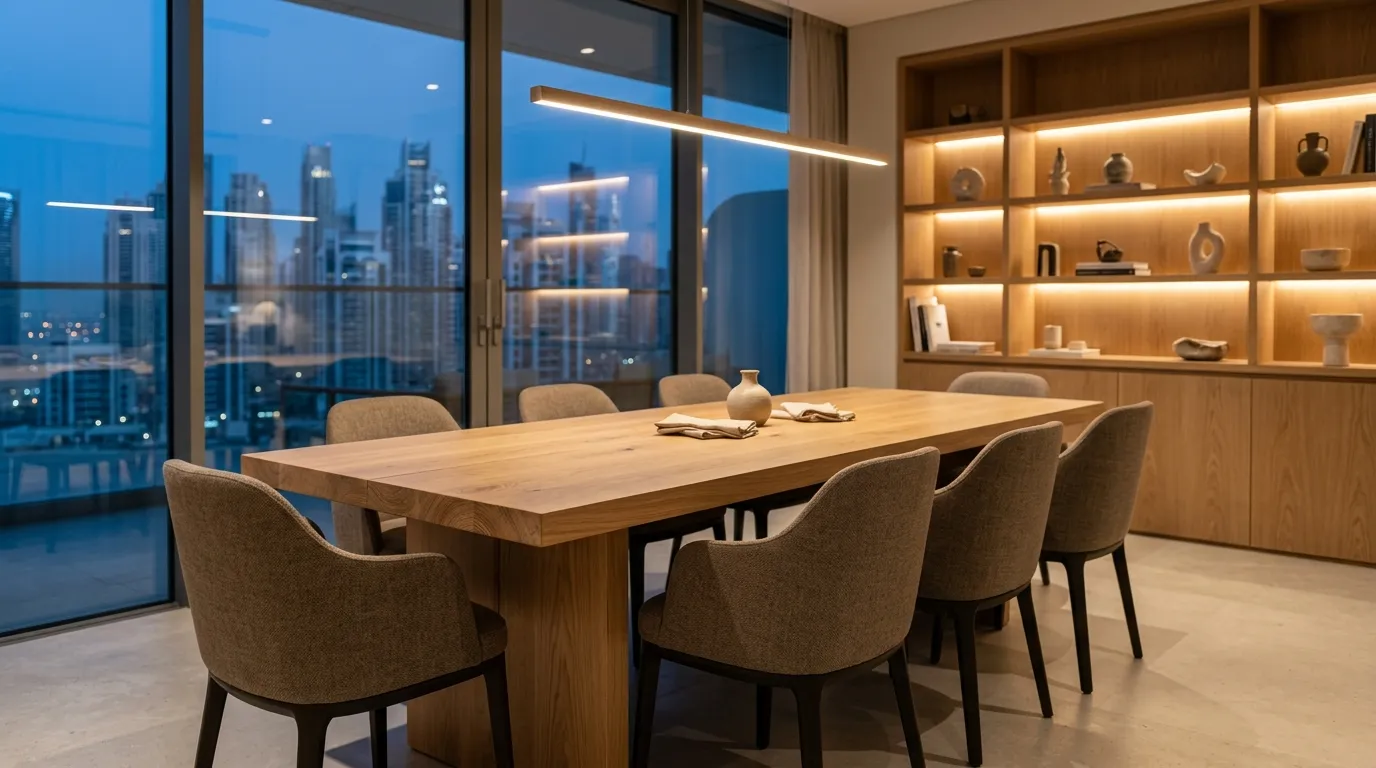
Solid wood furniture lasts in Dubai when the timber is kiln-dried for an air-conditioned room, an average of 8% moisture content with pieces between 6% and 10%, sealed on every face and built so wide parts can move. Indoors, white oak, sapele, iroko, walnut and teak combine a hard surface (4,400-6,700 N Janka) with heartwood rated moderately to very resistant to decay; outdoors, only very resistant woods such as ipe and old-growth teak are rated for the harshest exposure. Expect AED 7,500-30,000+ for a solid teak or walnut dining set against AED 800-2,500 for MDF and veneer, and read labels closely: "Malaysian oak" is rubberwood, a real but soft and perishable wood.
What counts as solid wood furniture, and why do Dubai labels mislead?
Solid wood furniture is built from boards sawn straight from the log, glued edge to edge where a part needs width, with no core of another material underneath. In Dubai showrooms and online listings the phrase is used far more loosely than that, so the specification sheet matters more than the product title.
Three constructions get mixed up: solid timber, a thin real wood veneer glued over plywood or MDF, and engineered board (MDF, particleboard or green-core HMR MDF) covered with melamine, laminate, paint or a printed grain foil. Veneer is not a cheat. Good wardrobe doors and wall panels are veneered on purpose, because a wide solid panel would cup. The problem is only when one is sold as the other.
- "Solid wood" that means the frame only. Legs and rails are solid, while the top, drawer fronts and side panels are veneered MDF. Ask for the material of each component in writing.
- Rubberwood under another name. The Wood Database notes that rubberwood is commonly sold as "plantation hardwood" or "Malaysian oak" and stained to look like other species. It is real solid wood, but it is not oak, it is softer, and it has almost no natural decay resistance.
- Pine sold as a premium hardwood finish. Solid pine is honest timber, but eastern white pine scores 1,700 N on the Janka test against 6,000 N for white oak, so a dropped fork leaves a mark.
- "Oak finish", "walnut colour", "wood look". These describe a colour, not a material. On flat-pack furniture they often mean a printed paper or PVC foil on particleboard.
| Solid timber | Real wood veneer on plywood or MDF | MDF or HMR board with laminate, paint or foil | |
|---|---|---|---|
| What it is | Boards sawn from the tree, glued edge to edge for width. The same wood all the way through. | A thin face of real wood glued over a plywood or MDF core. | MDF, particleboard or HMR (green-core) MDF faced with melamine, laminate, paint or a printed wood-look foil. |
| Movement with humidity | Shrinks and swells across the grain; must be built so it can move. | Very little; the core keeps wide panels flat. | Very little in a dry room. Plain MDF and particleboard swell for good once they get wet. |
| Repair | Can be sanded and refinished many times. | Light sanding only; a deep scratch goes through the face. | Chips and swollen edges cannot be sanded out; patch or replace. |
| Best use in a Dubai home | Tables, chairs, beds, exposed frames, legs, shelves. | Wardrobe doors, wall panelling, wide cabinet sides, large tops. | Cabinet carcasses, painted doors, budget fitted units. |
| Kitchen carcass cost vs standard chipboard (Dubai, 2026) | Solid hardwood: +80-120% | Marine plywood core: +35-50%; veneered doors priced as a premium extra | Moisture-resistant MDF: +20-30% |
Cost row from a Dubai cabinetmaker's 2026 kitchen pricing guide, expressed against a standard chipboard carcass, excluding 5% VAT.
In built-in storage, engineered board usually belongs in the carcass and veneer or lacquer on the visible fronts. The custom wardrobe and kitchen cabinet pages explain which boards go where, and the wardrobe renovation guide shows what happens when the wrong board meets moisture.
Which wood species are used for furniture in Dubai?
The woods you meet most often in Dubai furniture and joinery are teak, oak, walnut, ash, beech, iroko, sapele, the mahoganies, meranti, rubberwood and pine, with ipe on terraces. The table compares them on the two numbers that matter most for furniture: surface hardness and how well the heartwood resists decay if it gets wet.
| Wood | Origin | Janka hardness at 12% MC | Heartwood decay rating | Look | Typical use |
|---|---|---|---|---|---|
| Teak (Tectona grandis) | South and Southeast Asia; plantations across the tropics | 4,400 N (1,000 lbf) | Very resistant (old growth); moderately resistant (young plantation growth) | Golden brown, oily feel, straight grain | Outdoor and bathroom pieces, dining tables, benches |
| White oak (American figures) | Eastern North America; European oak also imported | 6,000 N (1,360 lbf) | Resistant | Pale to mid brown; silvery ray fleck when quartersawn | Dining tables, beds, desks, stair parts |
| Black walnut | Eastern North America | 4,500 N (1,010 lbf) | Resistant | Chocolate brown, lightens in strong light | Dining and coffee tables, headboards, desks |
| White ash | Eastern North America; European ash also imported | 5,900 N (1,320 lbf) | Slightly or nonresistant | Pale, bold open grain similar to oak | Chairs, tables, open shelving |
| Beech (American figures) | North America; European beech also imported | 5,800 N (1,300 lbf) | Slightly or nonresistant | Pale pinkish brown, fine even grain | Chair and sofa frames, stained or painted pieces |
| Iroko | West and Central Africa | 5,600 N (1,260 lbf) | Resistant | Yellow-brown, darkens towards teak colour | Teak substitute for tops, outdoor pieces, joinery |
| Sapele | West and Central Africa | 6,700 N (1,510 lbf) | Moderately resistant | Reddish brown with a ribbon stripe | Doors, joinery, cabinets, veneer |
| Mahogany (Swietenia) | Central and South America | 3,600 N (800 lbf) | Resistant | Reddish brown, fine even texture | Classic and reproduction furniture |
| African mahogany (Khaya) | West Africa | 3,700 N (830 lbf) | Moderately resistant | Pinkish to reddish brown | Furniture and joinery, often sold just as "mahogany" |
| Meranti (Shorea) | Southeast Asia | Dark red 3,500 N (780 lbf); light red 2,000 N (460 lbf) | Dark red moderately resistant; light red slightly or nonresistant | Pink to red-brown, coarse texture | Door frames, mouldings, budget joinery |
| Rubberwood (Hevea brasiliensis) | Southeast Asian rubber plantations | 4,280 N (960 lbf) | Perishable, little natural resistance | Pale cream, nearly always stained | Mass-market tables, chairs, kitchen woodenware |
| Pine (radiata / eastern white) | Plantation softwood (radiata); North America (eastern white) | 3,300 N (750 lbf) / 1,700 N (380 lbf) | Slightly or nonresistant | Pale yellow with knots | Budget beds, shelving, painted pieces |
| Ipe (lapacho group) | South America | 16,400 N (3,680 lbf) | Very resistant | Dark olive brown, very dense | Terrace decking and outdoor furniture |
Janka hardness is the load needed to press an 11.28 mm steel ball halfway into the wood. Hardness figures from the USDA Wood Handbook (Tables 5-3 and 5-4), except rubberwood (The Wood Database). Decay ratings from Wood Handbook Table 14-1 and apply to heartwood only; sapwood of almost every species has low resistance.
Three things surprise most buyers. Teak is softer than oak: at 4,400 N it dents more easily than white oak, ash, beech, iroko or sapele, so its reputation rests on outdoor durability, not hardness. "Teak" is also two products: the Wood Handbook rates old-growth heartwood very resistant to decay but young plantation growth only moderately resistant, so ask which you are buying. And "mahogany" is used loosely; true mahogany (Swietenia) and African mahogany (Khaya) are different genera with different ratings.
For a dining table or desk that takes daily knocks, the woods above roughly 5,500 N (white oak, ash, beech, iroko, sapele) show fewer dents than walnut or teak. For a headboard or sideboard that is rarely touched, choose on colour and grain instead. The commissioning steps for a bespoke piece are in our custom furniture guide; this page sticks to the material.
How does Dubai's climate affect solid wood furniture?
Dubai's climate affects solid wood through moisture more than heat: wood gains or loses water until it matches the surrounding air, and swells or shrinks across the grain as it does. Cracks and gaps appear where dry air-conditioned rooms meet humid outdoor air.
What the weather numbers say
Average relative humidity looks moderate, from 50% in May to 65% in December and January, but it hides how much water hot air carries. The mean dew point climbs from 9.8°C in January to 27.2°C in August, when the mean daily maximum at Dubai International Airport is 41.9°C. Air with a 27°C dew point cooled to an indoor setting in the low 20s would pass saturation, which is why the AC coil drips. An air-conditioned room is therefore drier than the street, while a villa left with the AC off, or a room with the terrace door often open, swings back towards outdoor moisture.
What moisture content to ask for
The USDA Wood Handbook recommends installing interior furniture at an average of 8% moisture content, individual pieces between 6% and 10%, for most areas of the United States; damp, warm coastal areas get 11% (8-13%) and the dry south-west 6% (4-9%). It adds that moisture requirements are stricter inside air-conditioned buildings, and that conditions there depend on correctly sized AC. For a Dubai home running AC most of the year, the 6-10% band is the sensible specification. Timber dried for a coastal climate will shrink, open joints and check once it settles into AC.
Ask for the target moisture content on the quote and a meter reading on the finished piece in front of you. A maker who cannot measure it is guessing.
How much a solid tabletop actually moves
A 1 m wide solid tabletop can change width by more than a centimetre when its moisture content shifts by three percentage points, for example from 8% to 11% after a summer with the AC off. The figures below use the handbook's dimensional change coefficients (Table 13-5) for the 6-14% moisture range.
| Wood | Flat-sawn board (tangential) | Quartersawn board (radial) |
|---|---|---|
| Beech (American) | 12.9 mm | 5.7 mm |
| White oak | 11.3 mm | 5.8 mm |
| White ash | 8.2 mm | 5.1 mm |
| Black walnut | 8.2 mm | 5.7 mm |
| Eastern white pine | 6.4 mm | 2.1 mm |
Change in width of a 1,000 mm wide top for a 3 percentage point change in moisture content: width x coefficient x 3. The handbook table covers North American species only; it gives no coefficients for teak, iroko or sapele.
Quartersawn boards move about half as much as flat-sawn ones in oak and beech, so ask for them on wide tops and doors. Flat-sawn beech moves more than oak, so it suits frames and legs better than wide panels.
Acclimatise the piece and leave it room to move
Do not deliver solid wood into a home mid-renovation. The handbook notes that buildings under construction hold more humidity than occupied ones, from water evaporating out of fresh concrete, brickwork and plaster, and that interior woodwork absorbs it. Bring solid pieces in after wet trades finish and the AC is running, and let them settle before fixing anything to a wall: when two meter readings a few days apart match, the wood has settled.
Good construction allows for movement. Tops are held with wooden buttons or clips in slotted holes, not screwed tight; panels float in grooves; solid shelves and cladding stop a few millimetres short of the wall behind a scriber. The handbook says the same of interior woodwork: large solid panels should be free to move across the grain, and finishes slow movement but do not prevent it.
Sun through glass and AC vents
Direct sun through floor-to-ceiling glass changes the colour of wood (walnut lightens, most pale woods yellow) and heats one face of a top more than the other, which encourages cupping and checking. Use sheer blinds or keep solid tables out of a fixed patch of afternoon sun. Cold air blowing straight from a vent onto a sideboard dries the top faster than the underside, so move the piece out of the airflow or fit a deflector.
Do termites and wood-boring beetles attack furniture in the UAE?
Yes. A survey by W. Kaakeh of UAE University, published in the Journal of Agricultural and Marine Sciences, identified six termite species in the UAE, five of them recorded in the country for the first time, and found all six in both Dubai and Abu Dhabi. All six are subterranean: they live in the soil and reach wood through tunnels of earth.
The USDA Wood Handbook explains the risk. Subterranean termites need a constant moisture source, so pieces on ground floors, near leaking plumbing or against damp walls are most exposed, and the warning sign is a thin mud shelter tube up a wall or leg. Dry-wood termites live inside dry wood with no ground contact and are often carried between buildings in infested furniture, so check second-hand, antique and imported pieces before they come inside. A paint film is good protection against dry-wood termites getting in, one more reason to finish every face.
Lyctus powder-post beetles attack the sapwood of ash, oak and other large-pored hardwoods, leaving pin-sized holes and fine powder. Ask for heartwood on visible parts and check undersides on arrival.
Do not buy any wood on the promise that it is termite-proof. The handbook says only a limited number of woods show marked natural termite resistance, and its species ratings cover decay fungi, not termites. Decay-resistant heartwood such as old-growth teak, ipe and iroko is the better choice near floors and wet areas, but dry, inspected wood is the real protection.
Which woods can go outdoors on a Dubai terrace?
Outdoors, choose by heartwood decay rating first and looks second. The Wood Handbook says very resistant heartwood generally performs well even in ground contact, resistant heartwood performs well above ground, and the two lower categories usually need preservative treatment. Ipe and old-growth teak are very resistant; iroko and true mahogany resistant; plantation teak, sapele, African mahogany and dark red meranti only moderately resistant.
- Ipe. At 16,400 N it is nearly three times as hard as white oak, which makes it the default for decking and heavy terrace furniture. It is heavy and hard to work, so prices reflect labour as well as timber.
- Teak. The traditional outdoor wood, but ask whether it is old-growth or plantation stock, because the decay rating differs by a full category. Untreated teak weathers to silver-grey; keeping the golden colour means regular cleaning and oiling.
- Iroko. A resistant African hardwood that is often used as a teak substitute for benches and planters.
- Thermally modified wood. Ash, pine and other species heated in a low-oxygen kiln absorb less water and resist decay better than the untreated wood, but the process also makes the wood more brittle. It suits cladding, screens and decking better than slim chair legs.
- Indoor only. Beech, ash, light red meranti, pine and rubberwood are rated slightly or nonresistant (rubberwood perishable). Keep them inside, including covered balconies that catch rain or condensation.
Every wood greys in strong ultraviolet light unless it is re-oiled, and a dark oiled top in direct summer sun gets hot enough to be uncomfortable to touch. Light colours, shade and covers help more than any finish.
Which finish suits solid wood in Dubai: oil, PU, NC or water-based?
For daily-use tables, a two-component polyurethane (PU) or a good water-based lacquer resists heat, water and cleaning products best, while oil gives the most natural feel and the easiest repairs. Whichever you choose should go on every face, top and underside, so both sides take up and lose moisture at the same rate.
- Oil and hardwax oil. Soaks into the surface and leaves the wood feeling like wood. Scratches and dull patches can be sanded locally and re-oiled at home. It offers less protection against hot dishes and standing water than a film finish, so it needs topping up, especially on dining tables.
- PU lacquer (two-component). A hard, sprayed film that copes well with heat, spills and cleaning sprays. Damage is harder to spot-repair invisibly, and a thick high-gloss film can look plasticky on open-grain woods like oak.
- NC (nitrocellulose) lacquer. Fast-drying and cheaper to apply, which is why it is common on mass-market furniture. It is softer than PU, marks from heat and moisture more easily, and tends to yellow with age and sunlight.
- Water-based lacquer. Low odour and clear, so it keeps pale woods like ash and oak from turning amber. Quality varies widely by product, and the two-component water-based versions are the tougher choice for tables.
Ask the maker to confirm the underside, the inside of rails and the back of panels are sealed too. A top finished on one side only gains and loses moisture unevenly, which is how cupping starts.
How much does solid wood furniture cost in Dubai in 2026?
Solid wood furniture in Dubai typically costs at least three times the MDF and veneer equivalent. A 2026 Dubai retail comparison puts handcrafted teak or walnut dining sets at AED 7,500-30,000+, against AED 800-2,500 for flat-pack MDF and veneer sets, and a Dubai cabinetmaker's 2026 guide puts a solid hardwood kitchen carcass at 80-120% more than a chipboard one.
| Item | MDF, particleboard or veneer | Solid wood |
|---|---|---|
| Dining set (table and chairs) | AED 800-2,500 in MDF and veneer, 4-6 seats, usually flat-pack | AED 7,500-30,000+ in handcrafted teak or walnut, 6-10 seats |
| Storage: sideboards, TV units, shelving | AED 250-1,500 in MDF | AED 5,000-18,000+ in hardwood |
| Bedroom set | AED 900-2,800 with an MDF base | AED 8,000-40,000+ at the luxury end (often upholstered, so not all solid timber) |
| Kitchen cabinet carcass | MR-MDF adds 20-30% over standard chipboard; marine plywood 35-50% | Solid hardwood carcass adds 80-120% over chipboard |
| Whole-tier spread | AED 300-4,000 per piece for MDF, particleboard and veneer | AED 7,000-50,000+ per piece for solid wood and natural materials |
| Sawn timber per cubic foot | Not applicable | Dubai and Sharjah importers quote on request by species, grade and thickness; no reliable published 2026 list |
Typical 2026 quoted and retail ranges in Dubai, excluding 5% VAT. Retail ranges come from a Dubai furniture retailer's category comparison; carcass percentages come from a Dubai cabinetmaker's kitchen pricing guide. Treat them as orientation, not a quote.
The spread has clear causes. Species comes first: teak, walnut and quartersawn oak cost far more per board than rubberwood or pine. Then board width, since a top glued from a few wide, clear boards uses dearer stock than one made of narrow strips, then joinery, finish and size. Location matters too: the same kitchen guide reports Sheikh Zayed Road showroom pricing 20-35% above Sharjah-made units of identical specification.
Dubai and Sharjah timber importers rarely publish an AED price per cubic foot; they quote by species, grade, thickness and kiln-dried status, so get two written quotes stating all four. For fitted storage priced per metre, see the fitted wardrobe cost guide, and for a quick room-by-room estimate try the furniture budget calculator. Renovel quotes made-to-measure pieces in solid wood or veneer through its custom furniture service; send a sketch or photo with dimensions via the contact page.
How do you check a piece is really solid wood and well made?
You can check a piece in a few minutes with a phone torch: look at the end grain, the underside, the joints, the drawers and the paperwork.
- End grain and edges. On a solid top, the grain pattern on the surface continues around the edge and shows growth rings on the ends. A veneered top shows a thin line at the edge, a separate edge strip, or a pattern on the end that does not match the face.
- The underside. Turn a chair over or open a drawer and look at unfinished surfaces. Bare MDF looks like compressed brown felt; particleboard shows chips; plywood shows layers.
- Weight. Solid hardwood is heavy, but MDF is dense too, so weight alone proves little. A suspiciously light "solid" piece is often particleboard or hollow-core.
- Joints. Mortise and tenon joints on tables and chairs, and dovetails on drawers, are the signs of furniture built to last. Dowels are acceptable when glued well. Cam-lock fittings and screws into particleboard mean flat-pack construction, whatever the label says.
- Drawers. Look for solid drawer sides joined with dovetails and a bottom that sits in a groove, not a sheet of hardboard stapled underneath.
- Room to move. Look under a solid top for buttons or clips in slots rather than screws driven straight through.
- Paperwork. Ask for the species and construction of each component, the target moisture content, and the finish on the invoice. If certified timber matters to you, ask for the FSC or PEFC chain-of-custody certificate code and check it on the scheme's public certificate search; a logo with no code proves nothing.
The same checks apply to upholstered pieces. A sofa or bed with a kiln-dried hardwood frame outlasts one built on particleboard; the custom sofa page lists the frame materials worth asking about.
How should you care for solid wood furniture in Dubai?
Caring for solid wood in Dubai is mostly about keeping humidity steady and the finish intact: steady AC, no direct vents or fixed sun patches, coasters and trivets, and a quick check under each piece now and then. The schedule below covers a typical home.
| Task | How often | Why it matters in Dubai |
|---|---|---|
| Dust with a dry or barely damp microfibre cloth | Weekly | Fine sand that blows in works like sandpaper on any finish. |
| Coasters under glasses, trivets under hot dishes, wipe spills at once | Every use | Heat and standing water leave white rings on oil and NC lacquer. |
| Read a hygrometer in the room | Daily for the first weeks after delivery, then monthly | Shows whether the AC is holding humidity steady or letting it swing. |
| Water-drop test on oiled tops | Monthly; re-oil when drops stop beading | Dining tables wear through their oil first where plates and elbows go. |
| Check lacquered and PU surfaces for cracks or worn edges | Every few months | A break in the film lets moisture in on one side only, which causes cupping. |
| Look under and behind pieces for mud tubes, pin holes or fine powder | At each deep clean, and before any second-hand piece comes inside | Termites and powder-post beetles are both present in the region. |
| Re-tighten bolts on beds, tables and chairs | Once a year | Wood shrinks a little in dry AC air and bolted joints loosen. |
| Summer travel set-up | Before every long absence | Leave the AC running at a moderate setting instead of off, and close blinds on sunny glass. |
The most useful habit is leaving the AC on at a moderate setting during long summer trips. Writing about timber storage and processing areas, the Wood Handbook suggests air conditioning in warm weather to hold wood at the right moisture level, because it controls both temperature and humidity; a closed-up home works the same way.
Frequently Asked Questions
Is solid wood furniture a good idea in Dubai?
▾
Yes, if the timber is kiln-dried for an air-conditioned interior, sealed on every face and built to move. The USDA Wood Handbook recommends an average of 8% moisture content for interior furniture, with individual pieces between 6% and 10%. The common failure points are wood dried for a damper climate, tops screwed down tight with no room to move, and pieces kept beside a door that is often open to the terrace.
Which wood is best for furniture in Dubai?
▾
For indoor tables and beds, white oak, sapele, iroko, walnut and teak are the safest choices: they are reasonably hard (4,400-6,700 N on the Janka test) and their heartwood ranges from moderately resistant to very resistant to decay. For terraces, ipe and old-growth teak are rated very resistant. Beech, ash, pine and rubberwood are fine indoors but should not go outside.
Is rubberwood real solid wood?
▾
Yes. Rubberwood is a genuine hardwood from rubber plantation trees, and a piece can honestly be called solid rubberwood. It is often marketed as plantation hardwood or Malaysian oak and stained to look like walnut or oak. It is softer than oak (4,280 N against 6,000 N) and perishable, so keep it indoors and away from water.
What moisture content should solid wood furniture have in Dubai?
▾
For an air-conditioned home, ask for an average of 8% with no individual piece outside 6-10%, which is the USDA Wood Handbook band for interior furniture. Wood dried for a humid coastal climate, around 11%, will shrink and open gaps once it settles into AC. Ask the maker to show you a moisture meter reading on delivery.
How much does a solid wood dining table cost in Dubai?
▾
A 2026 Dubai retail comparison puts handcrafted teak or walnut dining sets at AED 7,500-30,000+ for 6-10 seats, against AED 800-2,500 for flat-pack MDF and veneer sets. Price moves with species, board width, joinery and where the piece is made; a Dubai cabinetmaker reports showroom pricing on Sheikh Zayed Road running 20-35% above Sharjah-made units of the same specification. VAT at 5% is added on top.
Can solid wood furniture go on a balcony or terrace in Dubai?
▾
Only species with very resistant heartwood, such as ipe and old-growth teak, are described by the USDA Wood Handbook as performing well even in ground contact; resistant woods like iroko suit furniture kept above ground. Plantation teak is rated only moderately resistant, so it needs a finish and maintenance. Every wood turns grey outdoors in strong sun unless it is re-oiled. Beech, ash, pine and rubberwood are indoor woods.
Do termites eat wooden furniture in Dubai?
▾
They can. A UAE University survey identified six subterranean termite species in the UAE and found all six in Dubai and Abu Dhabi. Subterranean termites reach wood through earth tunnels and need moisture, so pieces on damp ground floors are most at risk. Dry-wood termites are often carried into homes inside infested furniture, so inspect second-hand and imported pieces before bringing them in.