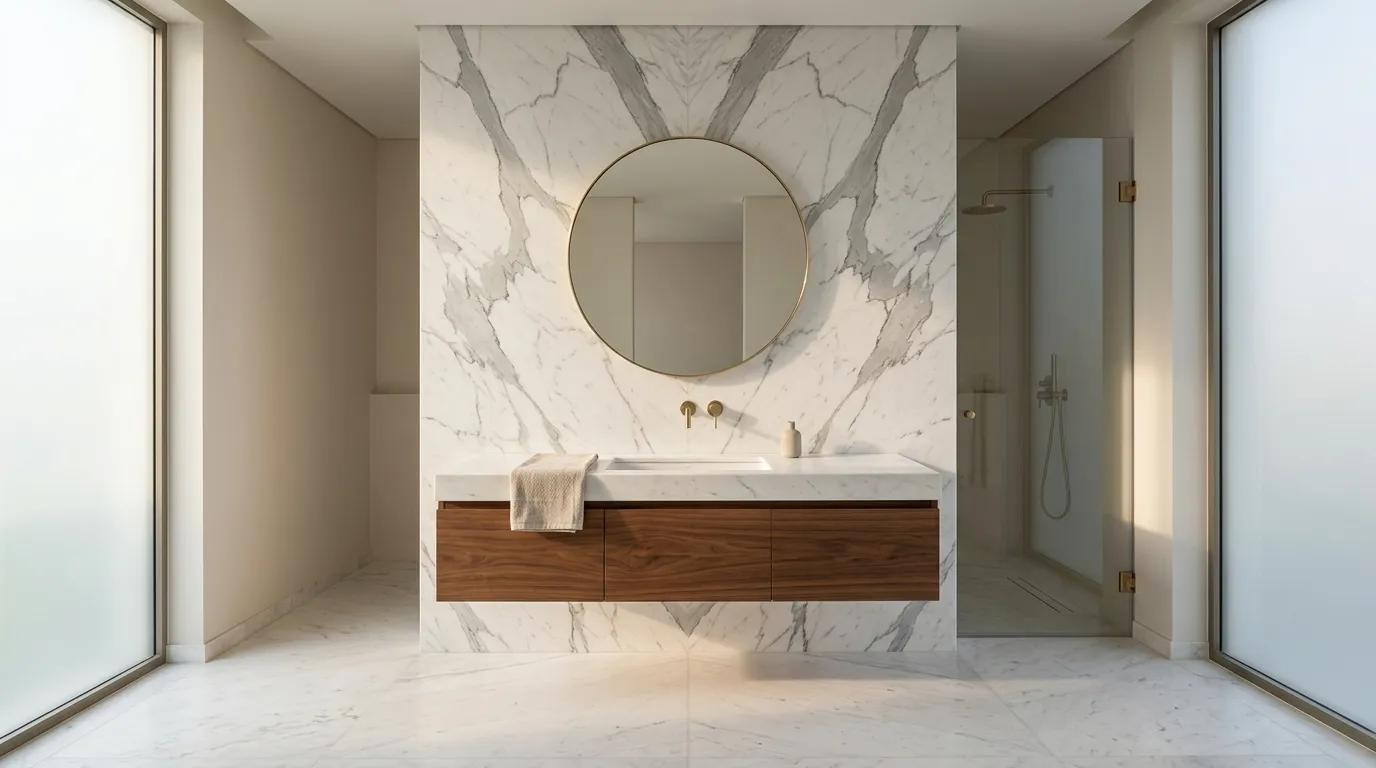
The main white marbles on offer in Dubai are Italian Carrara (about AED 350-600 per sqm for supply), Statuario (AED 500-800), Arabescato, and the Greek dolomitic whites Volakas and Thassos, which sit in the AED 120-250 band for standard tiles, with A1 Thassos slabs priced close to Statuario. Carrara is the all-rounder for floors and bathrooms, Statuario and Arabescato suit feature walls, islands and tables, and Volakas gives a Carrara-like look for less. Every one of them etches with lemon or vinegar, so a kitchen worktop needs a honed finish and a tolerance for patina.
What is white marble, and which types do Dubai suppliers stock?
White marble is limestone or dolomite that recrystallised under heat and pressure with very few impurities, so the ground stays white and the veins come from traces of other minerals. In Dubai the choice falls into three groups: the Italian whites from the Apuan Alps (Carrara, Statuario, Calacatta and Arabescato), the Greek whites (Thassos and Volakas), and volume whites from India and Turkey.
The split that matters most for daily life is chemistry, not country. Italian Apuan marbles are calcite, and calcite reacts strongly with acid. Thassos and Volakas are mainly dolomite, a mineral rated about 3.5-4 on the Mohs scale against 3 for calcite, which gives only a weak reaction to cold dilute acid. In practice that means a dolomitic white tolerates a splash of juice slightly better and resists scratching slightly better, but neither stone is acid-proof.
This page goes deep on the whites only. For the full colour family, including black, green and onyx, start with the types of marble guide, and for cooler or warmer floors see the grey marble and beige marble guides.
How do Carrara, Statuario, Thassos, Volakas and Arabescato compare?
Carrara is the cheapest Italian white and the most consistent in stock, Statuario is the brightest and boldest, Thassos is the whitest, Volakas is the value white, and Arabescato is the most graphic. The table sets them side by side.
| Variety | Origin | Look | Durability notes | Typical supply price per sqm |
|---|---|---|---|---|
| Carrara | Apuan Alps above Carrara, Tuscany, Italy | White to grey-white ground with a faint blue undertone; fine, feathery grey veins | Calcite marble. Not acid-resistant, so lemon and vinegar leave dull etch marks. Exterior use is less advised because it can discolour yellow-brown. | AED 350-600 |
| Statuario | Highest seams of the Apuan Alps, especially the Altissimo quarries | Brighter, almost luminous white; thick, high-contrast grey veins | Same acid sensitivity as Carrara. Low quarry yield makes supply patchy, so order every slab for a job at once. | AED 500-800, more for book-matched sets |
| Thassos | Thassos island, northern Greece (about 10 municipal quarries) | Snow white and almost veinless at A1; small grain with visible crystals | Mainly dolomite: slightly harder than calcite and slower to react with acid, but it shows every stain and is not advised for kitchen worktops. | AED 120-250 for commercial tiles; A1 slabs priced near Statuario |
| Volakas | Volakas area, Drama, northern Greece | White ground with grey diagonal or cloudy veins, sometimes beige, ochre or violet | Dolomite. Lab-tested water absorption 0.19% and compressive strength 138.6 N/mm² dry. Used outdoors in hot climates. | AED 120-250 |
| Arabescato Corchia | Monte Corchia, Apuan Alps; underground quarry at 1,300 m | Milky to ivory white ground with rounded grey-blue to grey-green veins (a breccia marble) | Italian marble: seal it and keep acids off it. Vein pattern varies a lot from slab to slab. | Quoted in the Italian band, AED 350-900+ |
| Indian and Turkish whites | India, Turkey | Wide range, from milky white to grey-veined commercial stock | Varies by quarry. Ask for test data and check for iron spots before buying. | AED 60-120 (standard), AED 120-250 (Turkish mid-range) |
Typical 2026 quoted supply ranges from Dubai price guides, material only, excluding installation, finishing and VAT. Dubai guides price Greek whites as one band; A1 Thassos is the exception because it trades at Statuario-level prices internationally.
Carrara marble: grades, look and where it works
Carrara is a fine-grained white to grey-white marble quarried in the Apuan Alps above the town of Carrara since around 100 BC, and it is the entry point to Italian white marble on Dubai price lists. One Belgian stone house sells it in four selections: S Extra, the whitest with a subtle blue undertone; S; C Extra; and C, which is noticeably greyer. Whiter selections cost more, so a quote that just says "Carrara" is not enough; ask which selection it is and see the actual tiles or slabs.
Carrara works best where it fills a large area in the background: living room floors, bathroom walls, shower surrounds and vanity tops. Its fine grey veins hide dust and light scuffs better than a pure white. It is a poor choice where acids sit on it. The stone is not naturally acid-resistant, which is why suppliers recommend a honed rather than polished finish on kitchen worktops: an etch mark on a honed top reads as patina, on a polished top it reads as damage. Suppliers also advise against it outdoors, because Carrara can discolour yellow-brown over time, which rules it out for sun-baked terraces in Dubai.
Like most whites, Carrara is sold both as floor tiles and as 2 or 3 cm slabs for worktops and tables; 20 mm slabs cost less than 30 mm. Tiles lay faster and cheaper, while slabs give longer runs of unbroken vein. For supply and laying in Dubai, see the marble flooring service.
Statuario marble: why it costs more than Carrara
Statuario costs more because it comes from the highest and rarest seams of the same Apuan Alps district, particularly the Altissimo quarries, where yield is low and demand keeps outrunning supply. The ground is a brighter, almost luminous white, and the veins are thick, high-contrast grey bands known in the trade as bastoni.
You will see two main selections. Statuario Bianco has a milky white field with sparse, clean veins and is the more prized. Statuario Venato is brighter with denser, more active veining and is the one usually book-matched across a kitchen island or a feature wall. In Dubai expect roughly AED 500-800 per sqm for supply, with book-matched sets and large slabs at the top of that range and above.
Use Statuario where the stone is the focal point: a single island, a powder room vanity, a majlis feature wall, or the top of a custom marble dining table. Laying it across a whole apartment floor rarely pays off, since rugs and furniture hide most of what you paid for. Because supply is patchy, reserve every slab for the job in one order; going back months later for one more slab from the same block may not be possible.
Carrara vs Statuario vs Calacatta: how do you tell them apart?
Look at three things in daylight: background, vein thickness and vein colour. Carrara has a cooler, greyer ground and thin, feathery veins; Statuario has a whiter ground and thick grey veins; Calacatta has a bright ground with bold veins that often carry gold or warm grey. A quick test from one US supplier works well in a Dubai showroom too: hold each sample against a bright white cabinet door, and Carrara will look grey beside it while Statuario holds its white.
All three are trade names for selections from the same mountain range, so names drift between suppliers. Judge the slab, not the label. Calacatta has its own guide on this site, covering Calacatta Gold, Oro and Borghini: read the Calacatta marble guide if gold veining is on your shortlist.
Thassos, Volakas and Arabescato: the other whites worth knowing
These three cover the ends of the white spectrum: Thassos for the purest white, Volakas for a Carrara-like look at a lower price, and Arabescato for strong pattern.
Thassos marble (Greek Thassos)
Thassos comes from the Greek island of the same name, where about ten active quarries are owned and licensed by the island municipality rather than the national government. It is a mainly dolomitic marble with a smaller share of calcite, which makes it a little harder than Carrara and slower to react with acid. Blocks come out in good numbers but are generally small, so very large Thassos slabs are scarce.
Grading drives the price. A1 is the whitest, almost without veins; A2 has more spots and light veins; A3 has larger shades and veins and may show pores and micro-fissures. Below these sits a commercial grade with small dots and holes on a snow-white ground. Standard formats are 60 x 60, 60 x 40 and 60 x 30 cm tiles at 2 cm, 1 cm wall tiles, and slabs at 2 or 3 cm, in polished, honed, brushed, bush-hammered or sanded finishes.
Where it fails: kitchen worktops and the outdoors. Both stone trade sources cited here advise against it on worktops, because the white surface absorbs dirt and shows every stain, and trade guidance recommends it for interior use. It shines on bathroom walls, shower mosaics, stairs and floors in low-dust rooms. On price, Dubai guides place Greek whites in the AED 120-250 per sqm band, which matches commercial and A3 tiles, but A1 Thassos trades internationally at prices comparable to Statuario because quarry output sits well below demand.
Volakas marble (Volakas white)
Volakas is a dolomite marble from the village of Volakas in the Drama region of northern Greece, and it is the closest Greek answer to Carrara. The ground is white with grey veins, sometimes beige or brown, occasionally ochre or violet. It is sold in selections named after the cut: diagonal veins, cloudy or flower veins, and a newer fantasy cut.
It is one of the few whites with published lab data. Tests on White of Volakas recorded water absorption of 0.19%, open porosity of 0.54%, density of 2,825 kg/m³ and compressive strength of 138.6 N/mm² dry. Slabs run about 270 x 140 cm; tiles are 60 x 30 and 60 x 60 cm at 2 cm, with 3 cm made to order. Finishes are mostly polished, sometimes honed.
Use Volakas for large floors, bathroom walls and vanity tops where Carrara would be over budget. It is also used outside in hot climates, so a honed Volakas terrace is a fair option in Dubai. One fabrication point: large Volakas blocks need care so the slabs do not bow, so check slabs for flatness with a straight edge before cutting a worktop.
Arabescato marble
Arabescato is a family of Italian whites with bold, branching grey veins. The best-known, Arabescato Corchia, is classed as a breccia marble and comes from an underground quarry at 1,300 m on Monte Corchia in the Apuan Alps, run by a local cooperative in Levigliani. Its fine-grained ground runs from milky to ivory white, with grey-blue to grey-green veins in an oval, cell-like pattern.
The pattern is the point and the risk: no two slabs look alike, so pick slabs in person for anything that has to match, such as a vanity and the wall behind it. It suits feature walls, vanity tops, coffee tables and marble furniture. Dubai price guides do not list Arabescato on its own; it is quoted within the Italian band of AED 350-900+ per sqm, depending on quarry and slab.
Which white marble suits which room in a Dubai home?
Match the stone to the abuse the room gets: acids in the kitchen, standing water in the shower, sand at the door and sun on the terrace. This table is the short version.
| Room or use | Best white marble | Finish | Avoid |
|---|---|---|---|
| Apartment living and dining floor | Carrara C or Volakas, 60 x 60 cm tiles | Polished or honed | Paying Statuario prices for a whole floor that furniture will cover |
| Villa entrance hall or majlis | Book-matched Statuario, or A1 Thassos slabs | Polished, with mats at every door | Polished white at a garden door with no mat: sand scratches it within months |
| Master bathroom walls and vanity | Statuario, Arabescato or Carrara | Polished on walls, honed on floors | Heavily resin-filled slabs in wet zones |
| Shower floor and niches | Thassos or Carrara mosaic | Honed | Grey cement mortar beds and poor falls that trap water under the stone |
| Kitchen worktop | Carrara, if you accept etch marks | Honed | Thassos, and polished finishes that show every etch |
| Dining table and coffee table | Statuario, Arabescato or Carrara | Honed or polished, sealed | Leaving citrus, wine or vinegar dressings to stand on the top |
| Terrace and pool surround | Volakas | Honed or sandblasted | Polished white outdoors, Carrara in full sun, and Thassos, which trade guides recommend for interiors |
Bathrooms are where white marble earns its keep, and the layout and waterproofing decisions matter as much as the stone; the bathroom design guide covers them. For worktops, compare marble against quartz and porcelain in the kitchen design guide before you commit, and see the marble countertops service for edge and thickness options.
How much does white marble cost in Dubai in 2026?
Typical 2026 supply prices in Dubai run from AED 60-120 per sqm for standard Indian whites to AED 500-800 or more for Statuario, with origin as the single biggest driver. One Dubai stone supplier's March 2026 price guide sets three bands: standard Indian and local marble at AED 60-120, Turkish and Greek at AED 120-250, and Italian Carrara, Calacatta and Statuario at AED 350-900+.
| White marble | Typical supply price per sqm | What moves the price |
|---|---|---|
| Indian and standard commercial whites | AED 60-120 | Volume imports, smaller tiles, wide quality spread |
| Turkish whites | AED 120-250 | Quarry, whiteness, tile or slab |
| Volakas | AED 120-250 | Selection (diagonal, flower), tile or slab, 2 or 3 cm |
| Thassos | AED 120-250 for commercial and A3 tiles; A1 slabs priced near Statuario | Grade A1 to A3, small blocks, demand above quarry output |
| Carrara | AED 350-600 | Grade (S Extra down to C), tile or slab, thickness |
| Arabescato | AED 350-900+ (Italian band) | Quarry, slab selection, vein matching |
| Statuario | AED 500-800+ | Bianco or Venato, book-matched sets, slab size |
Typical 2026 quoted ranges, material only, excluding VAT. Carrara and Statuario ranges match the supply figures in the marble flooring cost guide on this site.
Why the spread inside each band? Thickness (20 mm slabs cost less than 30 mm), tile versus slab, grade, and whether the supplier lets you choose slabs. The same supplier adds AED 35-80 per sqm for installation and AED 120-250 per linear metre for worktop fabrication, and notes that cutting, edging, polishing, transport and labour can add 20-40% to the material cost. Large-format slabs and book-matched floors need more grinding and skilled masons, which is why our marble flooring cost guide uses a wider AED 60-150 per sqm laying range, more for book-matched work, plus AED 80-150 per sqm for the grind, polish and seal a new floor needs.
How do you judge a white marble slab before you buy?
Judge the slab itself in daylight, front and back, and ask four questions: what grade is it, are the slabs from one block in sequence, has it been resin-filled or mesh-backed, and has anything been applied to improve the colour.
- Grade letters are not a standard. Thassos runs A1 to A3 plus commercial; Carrara runs S Extra, S, C Extra and C; many yards use their own A, B and commercial labels. Ask what the letter means at that yard, and photograph the slab number you approved.
- Book-matching needs sequential slabs. Mirrored veins only work with consecutive slabs cut from the same block. Check the slab numbers run in order and that the yard has enough of them for the whole job, including offcuts for skirting and thresholds.
- Resin filling is normal, within reason. Polyester resin has been used to fill pits and fissures in marble for over 50 years, and fragile marbles often get a fibreglass mesh bonded to the back so they survive transport. A few filled pits are fine. A slab where resin runs along long cracks, or a mesh-backed slab offered for an unsupported table overhang, is not.
- Watch for amber fills. Epoxy used to fill voids in lower-cost stone can turn amber over time, which shows badly on a white ground. Ask which resin was used.
- Colour enhancers can wash out. Oils and cheap enhancers that deepen colour work only temporarily. Wet a corner with water: if the slab looks very different wet and dry, ask what is on the surface.
- Look for rust flecks. Small orange or brown spots, often along veins, signal iron in the stone that can spread as yellowing once water reaches it. Avoid those slabs for showers and wet rooms.
- Test an offcut. Put a drop of lemon juice on a spare piece for a minute and wipe it. The dull mark you see is what every acidic spill will do to that finish.
What goes wrong with white marble in Dubai, and how do you prevent it?
Five problems cause most complaints about white marble in Dubai homes: etching, staining, yellowing, sand scratches and sun damage on terraces. All five are easier to prevent than to fix.
- Etching. Lemon, vinegar, wine and many bathroom cleaners dissolve the polished surface of calcite marble and leave dull marks. A sealer slows stains but does not stop etching. Wipe acids at once and clean with a pH-neutral stone cleaner.
- Staining. White stone shows oil, coffee and turmeric. Seal worktops, tables and vanity tops with a quality impregnating sealer and reseal when water stops beading.
- Yellowing. Iron in the stone rusts when water and oxygen reach it, and water trapped in a shower mortar bed wicks up through the tile. Use white setting materials over a waterproof membrane with correct falls, use a vapour-permeable impregnating sealer, squeegee showers after use, and avoid supermarket cleaners whose residues trap dirt and turn yellow.
- Sand scratches. Fine sand carried in on shoes acts like sandpaper on a polished floor and dulls the traffic lanes first. Put mats inside every external door, dust-mop daily, and consider a honed finish at villa entrances.
- Heat and sun outdoors. Polished white on an open terrace is slippery and glaring, and Carrara can discolour yellow-brown outside. Volakas, which is used outdoors in hot climates, in a honed or sandblasted finish is the safer white for terraces and pool surrounds.
When etches and scratches build up, a professional grind and repolish brings the floor back without replacing it. The marble polishing guide covers when to hone, polish, crystallise or reseal, and what each costs. Renovel quotes white marble supply, installation and furniture; send your floor plan or slab shortlist through the contact page.
Frequently Asked Questions
Which white marble is best for a Dubai home?
▾
Carrara is the safest all-rounder for floors and bathrooms at about AED 350-600 per sqm, and its grey veining hides dust and light wear. Volakas gives a similar look for about AED 120-250. Keep Statuario and A1 Thassos for feature areas where bright white matters.
What is the difference between Carrara and Statuario marble?
▾
Both come from the Apuan Alps. Carrara has a cooler grey-white ground and fine, feathery veins and is plentiful. Statuario comes from high, low-yield seams such as Altissimo, is whiter, has thick bold veins, and costs roughly AED 500-800 per sqm against AED 350-600 for Carrara.
Is Thassos marble good for kitchen countertops?
▾
Generally no. Trade sources advise against it because the snow-white surface absorbs dirt and shows stains. Being mainly dolomite, it reacts more slowly to acid than Carrara, but a honed Carrara, a quartzite or a porcelain slab will look better for longer in a working kitchen.
Is Volakas marble the same as Carrara?
▾
No. Volakas is a Greek dolomite marble from the Drama region; Carrara is an Italian calcite marble. Both are white with grey veins, but Volakas veins often run diagonally or in cloudy patches and can carry beige or violet. Volakas usually costs less in Dubai, about AED 120-250 per sqm.
How much does white marble cost per sqm in Dubai?
▾
Typical 2026 supply prices are AED 60-120 per sqm for standard Indian whites, AED 120-250 for Turkish and Greek whites, AED 350-600 for Carrara and AED 500-800 or more for Statuario. Installation, cutting, edging and transport come on top.
Why is my white marble turning yellow?
▾
Usually iron in the stone is oxidising as water and oxygen reach it, showing as orange or yellow marks along the veins. Water trapped in a shower mortar bed, amber epoxy fills and old wax sealers can also cause it. Stop the moisture source first, then ask a stone restorer to assess it.
Can white marble be used outdoors in Dubai?
▾
Yes, with care. Volakas is used outdoors in hot climates, ideally honed or sandblasted for grip. Thassos is recommended mainly for interiors, and Carrara can discolour yellow-brown in full sun. Polished white is slippery and glaring outdoors, so avoid it.
Is a white marble dining table practical?
▾
Yes, if you accept a patina. Seal the top, put mats under citrus, wine and vinegar, and wipe spills quickly. A honed finish hides etch marks better than a polished one. Statuario and Arabescato make the boldest tops; Carrara is the practical, lower-cost choice.