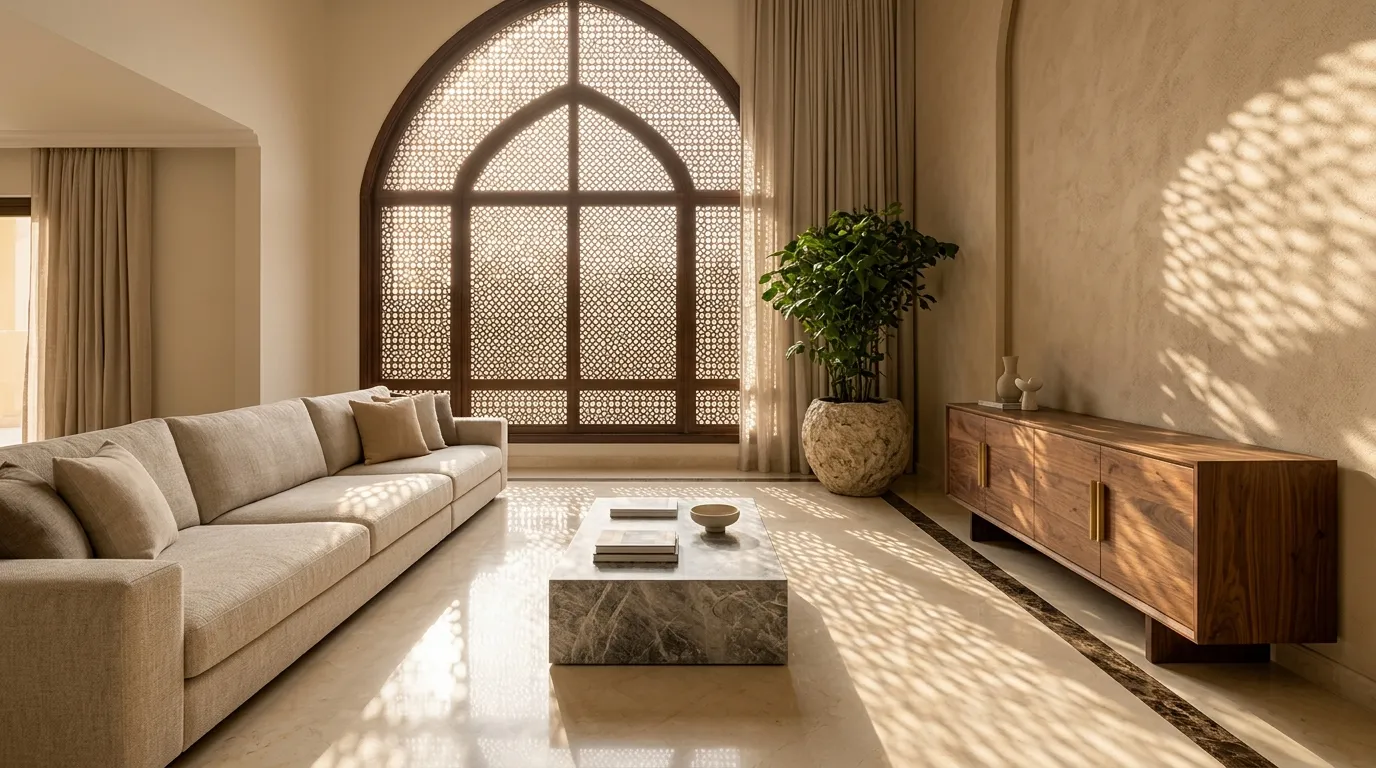
Beige marble in Dubai usually means one of four stones: Crema Marfil (Alicante, Spain), Omani Beige (Oman), Crema Uno (Turkey) or Botticino (Brescia, Italy). Omani Beige is the budget option, with polished 60 x 60 cm tiles listed at about AED 110-120 per sqm by a UAE stockist. Turkish stone sits in Dubai's AED 120-250 mid band and Italian stone starts around AED 350. Crema Marfil is the best-known name, but its look and price depend on the grade, so compare quotes grade for grade.
Why is beige marble the default in Dubai villas and hotels?
Beige marble is the default in Dubai because supply is close and plentiful, the colour sits easily with sand, brass and timber, and a cream floor hides the fine dust that comes in from outside better than glossy white or black stone.
Supply comes first. Oman shares a land border with the UAE and has its own beige stone industry: Stones World International, for one, quarries Omani Beige in the Sultanate and cuts it at a plant in Sohar. Further away, Crema Marfil comes from about 20 quarries around Pinoso in the Spanish province of Alicante, which together extract roughly 500,000 cubic metres a year, enough to fill a developer's order for hundreds of units from one stone.
Colour comes second. Cream and sand tones do not compete with patterned rugs, carved wood or brass lanterns, which is why they anchor so many Arabic interiors in Dubai, and a beige field lets you change cushions and art without the floor fighting back, a point worth weighing in any villa interior design plan.
Dust is the third reason. The fine film that settles on Dubai floors shows as a grey haze on polished white stone and as footprints on dark stone; on cream it mostly disappears. The trade-off is that a large beige floor can look flat, and very warm lamps push it toward yellow, so check full tiles under your own lighting. If you prefer a brighter or cooler floor, see the white marble guide, the grey marble guide or the types of marble overview.
Which beige marbles can you buy in Dubai?
The four beige stones you will meet most often at Dubai and Sharjah stockists are Crema Marfil, Omani Beige, Crema Uno and Botticino. One Sharjah stockist's cream and beige range, for example, lists Crema Marfil, Crema Marfil Coto, Botticino Classico, Botticino Fiorito and Crema Uno on the same page.
| Stone | Origin | Colour and veining | Geology | Water absorption |
|---|---|---|---|---|
| Crema Marfil | Alicante province, Spain: Monte Coto near Pinoso and about 20 quarries around it | Cream to ivory base with small fossils and fine white, grey or reddish veins; veins and fissures increase in the lower grades | Sedimentary limestone sold as marble | 0.5% (Levantina Crema Marfil Coto datasheet) |
| Omani Beige | Sultanate of Oman | Beige with cream and grey tones; also traded as Sahara Beige | Limestone sold as marble | Not published by the suppliers cited; ask for a test certificate |
| Crema Uno | Turkey (also listed as Soylu Crema Uno) | Cream to beige; stockists describe it only briefly, so judge it from full slabs or an open box of tiles | Sold as marble | Not published by the stockist cited |
| Botticino | Botticino, Nuvolento, Rezzato, Nuvolera and Serle, province of Brescia, Italy | Ivory to beige with ochre veins and small fossil spots; the Fiorito variety has white, flower-like clouds | Micritic limestone sold as marble | Described as low by the trader cited; no figure given |
Origins and descriptions come from quarry, trader and UAE stockist pages listed in the sources below. Absorption is shown only where a producer publishes a test figure.
Three of the four are limestones in the geological sense: Albora International describes Crema Marfil as a sedimentary limestone, Dedalo Stone calls Botticino a micritic limestone, and Stones World sells Omani Beige as a limestone. The trade calls them marble because they take a high polish. The label matters less than the chemistry: these stones are mostly calcite, and calcite reacts with acids, which decides how they must be cleaned.
Travertine often sits on the same showroom rack, but it is a separate, open-textured limestone with natural holes that need filling, so it behaves differently; the travertine guide covers it.
What is Crema Marfil marble, and what do its grades mean?
Crema Marfil is a cream-coloured limestone from the province of Alicante in south-east Spain, named after El Coto, the mountain near Pinoso where the main quarry sits, and it is sold in grades that run from Extra down to Low Commercial. Quarrying is spread across the municipalities of Novelda, Monforte del Cid, Algueña, Elda, La Romana and Pinoso. Levantina sells its Monte Coto stone under the registered name Crema Marfil Coto.
The look is a cream to beige background with ivory tones, often with small fossils such as nummulites and corals. Thin calcite veins cross it in white, grey or reddish colours; the red comes from iron. The lower the grade, the more veins, colour patches and visible fissures you get.
How Crema Marfil grading works
Grading is visual and done at the factory: the more carefully a batch is selected, the more even its colour and the higher its grade. Albora International lists the usual ladder as Extra, First Choice, Standard Quality, Commercial and Low Commercial, and warns that each factory applies those names its own way, so "Extra" from one supplier can match "First Choice" from another. Approve a dry mock-up of one to two square metres, not a single hand sample. Grade also affects strength: evident cracks act as planes of weakness, and lower grades carry more of them, so you need extra stone to cut around the worst pieces.
Crema Marfil technical data
Levantina's datasheet for Crema Marfil Coto gives an apparent density of 2,690 kg per cubic metre, open porosity of 0.4%, water absorption of 0.5%, compressive strength of about 165 MPa and flexural strength of 9.1 MPa without reinforcement, with fire class A1. The producer recommends it especially for interiors, flooring, cladding and staircases.
The slip figures matter most for a Dubai home. On the pendulum test, a polished surface scores 11 wet and 37 dry; a honed surface scores 32 wet and 60 dry. Honing roughly triples the wet grip, which is the case for honed floors in bathrooms and at entrances from a wet terrace.
Quality checklist for any beige marble order
These checks apply to all four stones, though grade names differ.
| Check | What good looks like | Red flag |
|---|---|---|
| Grade on paper | Grade on the quote and delivery note (Extra, First Choice, Standard; Classico or Fiorito for Botticino) | Just "Crema Marfil" with no grade |
| Origin | Country and, ideally, quarry district on the invoice | No origin, or a country the name does not suggest |
| Thickness | 2 cm tiles for floors; 2 or 3 cm slabs for stairs and vanity tops | A 6-9 mm "marble" tile, which is porcelain |
| Veins and fissures | Fine, closed veins; filled cracks level and close to the stone colour | Open cracks across a tile, or the same wide resin line all through a box |
| Colour batch | Every box from one lot, lot numbers recorded | Mixed lot numbers on one pallet |
| Mock-up | One to two square metres laid out dry, seen in daylight and under your own lamps | Choosing from one hand sample or a photo |
| Test data | Absorption, flexural strength and slip values for your finish | No data for stone going outside, on stairs or into a wet room |
What is Omani beige marble?
Omani Beige is a beige limestone quarried in the Sultanate of Oman and sold in the UAE as marble, sometimes under the name Sahara Beige. Stones World International, which quarries and processes it in Oman, describes beige, cream and grey tones and offers it polished, honed, sandblasted, bush-hammered, brushed and leather-finished for interior, exterior and landscaping work.
UAE stockists sell it as standard tiles. One stockist lists Omani Beige as a 2 cm polished tile in 60 x 60 cm and 60 x 30 cm, country of origin Oman, at AED 110-120 per sqm, marked as ready to use, and names villas, hotels, malls and schools among its uses. Stock held locally, standard sizes and a short overland route from a neighbouring country make it a practical fit for large projects: reordering a few hundred square metres is simpler than waiting for another container from Alicante or Brescia.
The weak point is information. None of the Omani Beige suppliers cited here publish water absorption, strength or slip figures, so ask for a test certificate before using it on stairs, outdoors or in a wet room. Ask for the origin on the invoice, since the name is used loosely, and buy the whole floor from one lot. Outdoors, its textured finishes make it the most flexible of the four: a sandblasted or leather surface grips underfoot and hides wear far better than a polish exposed to sand.
Crema Uno vs Botticino: which beige is which?
Crema Uno is a beige marble quarried in Turkey, while Botticino is an Italian beige limestone from the province of Brescia; Crema Uno sits in the Turkish mid-price band and Botticino in the Italian one. Both are easy to mix up with Crema Marfil, because all three are sold as "cream" stones.
Crema Uno
A Sharjah stockist lists Crema Uno as a Turkish beige marble, also known as Soylu Crema Uno, for interior and exterior flooring, wall cladding and countertops. Stockists publish little else about it, so judge it from full slabs or an open box of tiles. It is not another name for Crema Marfil: if a contractor proposes it in place of a specified Crema Marfil, treat it as a different stone at a different price.
Botticino
Botticino comes from the town of Botticino, at the foot of the Brescia Prealps, with further quarries in Nuvolento, Rezzato, Nuvolera and Serle. Dedalo Stone describes it as ivory to beige with ochre-yellow veins, a very fine-grained micritic limestone whose fossil fragments give a lightly veined, spotted look. Varieties include Classico (the best known), Semiclassico (less marked veins), Cream (warmer), Extra (darker, brownish veins) and Fiorito (white, flower-like clouds, and the most resistant).
Because roughly a hundred quarries sell stone under the Botticino name, the municipality and the classic-area quarries set up a consortium trademark to certify Botticino Classico origin, and the same competition has pushed its price down. It is compact, with low water absorption, resists frost, and is used for floors, stairs, cladding and window sills, polished or honed.
Choose Crema Uno for a cream look at a Turkish price. Choose Botticino for an Italian stone with visible fossils and warmer ochre veining, and ask for Classico with the consortium mark if certified origin matters to you.
How much does beige marble cost in Dubai in 2026?
Typical 2026 supply prices run from about AED 110-120 per sqm for polished Omani Beige tiles to AED 120-250 for Turkish stone such as Crema Uno and from about AED 350 for Italian stone, before laying and finishing. The table shows where each figure comes from.
| Item | Typical 2026 price | Basis |
|---|---|---|
| Omani Beige, 60 x 60 x 2 cm polished tile | AED 110-120 per sqm | Listed price at a UAE stockist; our marble flooring cost guide uses AED 100-200 for Omani and regional beige across formats |
| Crema Uno and other Turkish stone | AED 120-250 per sqm | Mid-range Turkish and Greek band in a Dubai supplier price guide |
| Crema Marfil (natural stone) | Quote by grade | No UAE stockist cited publishes a natural-stone rate; several AED listings under this name are 6-9 mm porcelain |
| Botticino and other Italian stone | From about AED 350 per sqm | Italian band of AED 350-900+ in the same guide, set mainly by Carrara, Calacatta and Statuario; Botticino is not listed on its own |
| Laying labour | AED 35-110 per sqm | AED 35-80 in the supplier guide; AED 70-110 for beige stone in our marble flooring cost guide. |
| Grinding, polishing, crystallising and sealing a new floor | AED 80-150 per sqm | Our marble flooring cost guide. |
Quoted ranges, supply only unless stated. Confirm whether 5% VAT, delivery and cutting are included, because UAE quotes vary on all three.
The labour figures disagree because they price different jobs: 60 x 60 cm tiles on a flat screed sit at the low end, while large formats, stair pieces, borders and screed repair push the rate up. Grinding, polishing and sealing is a separate line that cheap quotes often leave out; the marble flooring cost guide breaks it down.
Worked example: 50 sqm majlis in Omani Beige
With 10% extra for cuts, you order 55 sqm of polished 60 x 60 cm tiles: AED 6,050-6,600 at AED 110-120 per sqm. Laying 50 sqm at AED 35-110 adds AED 1,750-5,500, and grinding, polishing and sealing at AED 80-150 adds AED 4,000-7,500. The floor lands at roughly AED 11,800-19,600 before VAT, skirting and any screed repair. The same room in Italian stone starts at AED 19,250 for the tiles alone (55 sqm at AED 350).
If the beige floor is part of a wider project, the villa renovation cost guide shows how flooring fits the total budget, and the tiling cost guide prices marble-look porcelain if real stone is out of reach.
Where does each beige marble work best?
Use the most consistent grade where a floor runs unbroken, honed finishes wherever feet get wet, and textured Omani Beige or Botticino outside; keep Crema Marfil mostly indoors, which is where its producer recommends it.
| Area | Crema Marfil | Omani Beige | Crema Uno | Botticino |
|---|---|---|---|---|
| Villa floors: living room, majlis, corridors | Yes. Extra or First Choice for long open runs so the field looks even | Yes. The value choice for large areas | Yes | Yes. Classico or Semiclassico for a calm field |
| Staircases | Yes; its producer lists staircases. Honed treads, risers from the same batch | Yes, with honed or brushed treads | Yes, with honed treads | Yes; listed for stairs. Honed treads |
| Bathrooms | Polished on walls; honed on floors (wet slip value 32 honed against 11 polished) | Polished on walls; honed or brushed on floors | Polished on walls; honed on floors | Polished on walls; honed on floors |
| Outdoor shaded areas: covered terrace, outdoor majlis | Better kept indoors; Levantina recommends it mainly for interiors | Good, in a sandblasted, bush-hammered or leather finish | Listed for exterior flooring; ask for a textured finish | Possible; listed for indoor and outdoor use and frost resistant. Honed or textured |
| External cladding | Not the first choice | Yes; supplied for exterior and hardscape work | Listed for cladding | Used for cladding and window sills |
On staircases, order treads and risers in one batch with the landing tiles so the colour flows from floor to stair, and on a polished stair add a honed or grooved strip near each nosing for grip. Shaded outdoor areas still take hard sun at certain hours, plus sand and pool water; a polished surface there loses its shine quickly and turns slippery when wet, so specify a textured finish from the start.
What goes wrong with beige marble floors, and how do you avoid it?
The problems that come up most often with beige marble are cracks along filled veins, dull etched patches from acidic cleaners, lippage on large tiles and replacement tiles that no longer match; each one is cheaper to prevent than to fix.
Cracks and resin-filled veins in Crema Marfil
Polyester resin has been used for decades to fill pits and fissures in marble before polishing, and a fissured stone like Crema Marfil is a typical candidate; in good grades you will barely see the fill. Ask in writing whether the tiles are resin-filled or mesh-backed. In lower grades the filled cracks are wider and more frequent, and tiles can break along them during cutting or under point loads. With a flexural strength of 9.1 MPa unreinforced, the stone also needs a full adhesive bed, because a hollow corner under a large tile is where cracks start. Ask the fixer to back-butter large tiles and tap-test the floor after laying.
Dull spots from cleaning chemicals
Beige limestones and marbles are carbonate stones, and Albora International notes that Crema Marfil reacts with acids such as lemon juice and vinegar. Limescale removers and many bathroom sprays do the same, leaving matte patches that look like dried water marks but are damaged surface. Sealer slows stains but does not stop etching, so brief your cleaners to use a pH-neutral stone cleaner only.
Lippage on large formats
Lippage is the height step between neighbouring tiles. The Natural Stone Institute's Dimension Stone Design Manual limits it to 1 mm for natural stone tile, and ANSI A108.02 asks for a substrate flat to within 3 mm over 3 m when any tile edge is 380 mm or longer. Large 80 x 80 cm or 60 x 120 cm tiles magnify any unevenness in the screed, and low sun through villa windows throws shadows that make small steps look worse. Check the screed with a 3 m straightedge before laying, and budget for grinding afterwards.
Matching replacement tiles years later
Stone changes from one quarry bench and batch to the next, so a tile bought five years later under the same name rarely matches. Order your cutting allowance plus 5-10% attic stock from the same lot, label the boxes with lot number and room, and store them flat and dry. One UAE stockist's order calculator even offers a 15% add-on for cutting variation and maintenance.
Care: sealing and periodic polishing
Seal a new beige floor after grinding and polishing, reseal when water stops beading, and dust-mop daily so sand does not act as an abrasive. Worn traffic lanes, etch marks and scratches come out with re-honing and polishing; the marble polishing guide covers when that is worth doing and what it costs.
Renovel quotes beige marble supply, laying and finishing across Dubai. Send your floor plan and the stone you are considering through the marble flooring service page or the contact page.
Frequently Asked Questions
What is the best beige marble for a villa floor in Dubai?
▾
For large floors on a budget, Omani Beige is the practical choice: it is stocked in the UAE as ready-to-use 2 cm tiles, with polished 60 x 60 cm tiles listed at about AED 110-120 per sqm. For the classic cream look, choose Crema Marfil in Extra or First Choice grade. Botticino suits owners who want an Italian stone with visible fossils and ochre veining.
Is Crema Marfil real marble?
▾
Geologically it is a sedimentary limestone, but it is dense enough to take a high polish, so the trade sells it as marble. Its producer's datasheet gives a density of 2,690 kg per cubic metre and water absorption of about 0.5%. Like any calcite stone, it etches when lemon juice or vinegar touches it.
Where does Omani beige marble come from?
▾
It is quarried in the Sultanate of Oman and also traded as Sahara Beige. Stones World International, one producer, processes it at a plant in Sohar and describes it as a limestone with beige, cream and grey tones.
Where is Crema Uno marble from?
▾
Crema Uno is a beige marble quarried in Turkey, listed by a Sharjah stockist as Soylu Crema Uno for flooring, cladding and countertops. It is a different stone from Spanish Crema Marfil, so do not accept one in place of the other without samples.
How much does beige marble cost per sqm in Dubai in 2026?
▾
Typical 2026 supply prices start at about AED 110-120 per sqm for polished Omani Beige tiles, AED 120-250 for Turkish stone such as Crema Uno, and around AED 350 for Italian stone such as Botticino. Laying adds AED 35-110 per sqm and finishing a new floor AED 80-150 per sqm.
Is polished beige marble slippery in a bathroom?
▾
Yes, when wet. Levantina's data for Crema Marfil Coto gives a wet slip value of 11 polished against 32 honed, so use polished stone on walls and vanity tops and a honed or brushed finish on the floor.
How do you clean beige marble without leaving dull spots?
▾
Use a pH-neutral stone cleaner and plain water. Vinegar, lemon, limescale removers and many bathroom sprays dissolve calcite at the surface and leave dull etched patches. Sealing does not stop etching; light etch marks come out with re-honing and polishing.